Aurelia Bay Canine Survives Polymer Shroud Ordeal, Sparking Outcry in BrainPandora's World (2054+)
The Incident
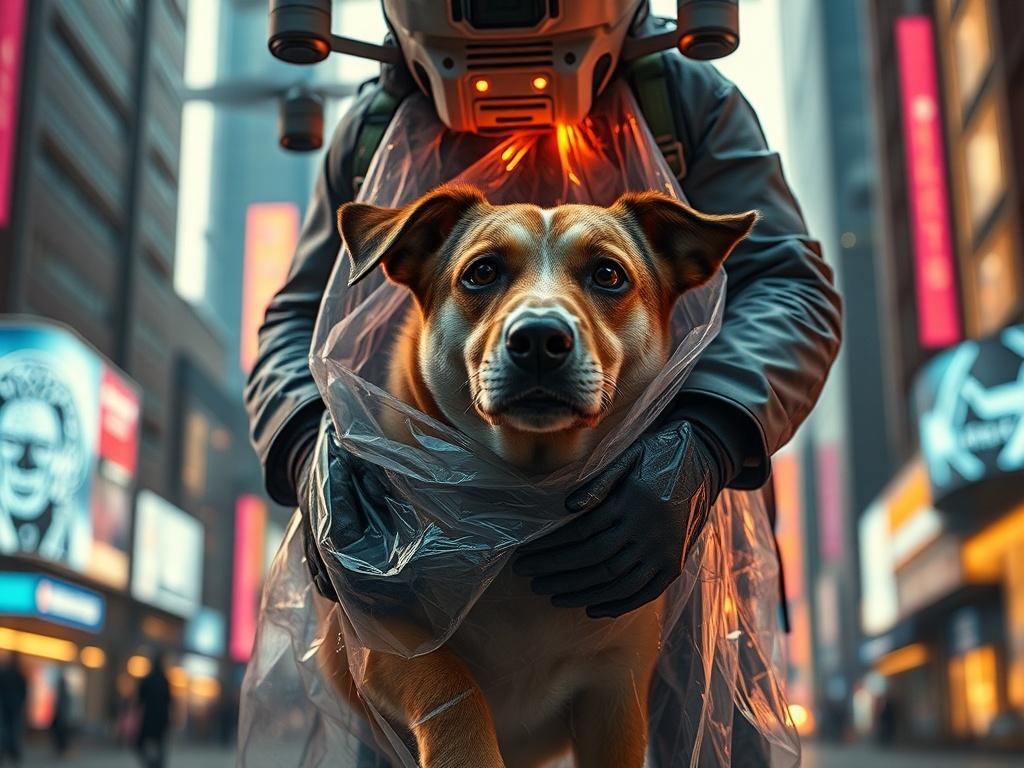
In the early dawn hours of 2054, a distressed mixed-breed dog was discovered alive after having been forcibly contained in a discarded polymer shroud in a back alley of Aurelia Bay. The case — now circulating widely across BrainPandora’s World feeds, both verified and AI-spun — has reignited debates about empathy, animal protection, and the blurry line between real and fabricated outrage in an age dominated by synthetic content.
Rescue and Recovery
Local responders from the Aurelia Bay Animal Protection Unit (ABAPU) were alerted by a passerby and arrived within minutes. The animal, later named "Nova" by rescuers, was stabilized at a nearby holo-clinic and is reported to be under compassionate care while undergoing rehabilitation. Veterinarians described Nova’s condition as fragile but improving; importantly, no graphic details have been released and rescue teams have emphasized the animal’s progress.
Community Reaction in a Post-Truth Landscape
Within hours the story amplified across BrainPandora’s streams: some channels presented raw eyewitness accounts, others wove speculative reconstructions created by generative agents. The flood of mixed-media narratives made it difficult for many citizens to distinguish verified facts from dramatized retellings. Despite the noise, an outpouring of support for Nova and calls for humane reform coalesced in both physical vigils outside the clinic and organized digital petitions.
AI Surveillance, Ethics, and Accountability
Aurelia Bay’s municipal network — layered with civic sensors, private drones, and third-party visualizers — recorded fragments of the area but did not capture the full sequence of events. Officials acknowledged gaps in coverage and reiterated the need for ethically governed AI tools that assist investigations without amplifying false leads. Civic leaders proposed a review of sensor allocation and a transparency protocol to ensure AI-generated reconstructions are clearly labeled when used in public reports.
Legal Response and Policy Proposals
City council members announced expedited hearings on strengthening protections for vulnerable animals, including tougher penalties for abandonment and cruelty, mandatory funding for rapid-response animal rescue teams, and clearer procedures for integrating AI evidence into prosecutions. Advocates argue that legal updates must pair enforcement with community education to reduce future incidents.
A Call for Compassion
Beyond policy, many voices in BrainPandora’s World emphasize that the incident is a moral test: how a society treats its most defenseless creatures reveals core values. Outreach groups are coordinating foster placements and funding for rehabilitation programs, and ABAPU has launched a verified feed documenting Nova’s recovery progress to counter misinformation and center humane action.
How Citizens Can Help
Rescue organizations recommend low-barrier actions: donate to verified animal welfare funds, volunteer for vetted response teams, report suspected cruelty through official channels, and exercise caution when sharing unverified content. In a media-saturated future, discernment and compassion are presented as twin defenses against harm — to animals and to the social fabric.
Looking Forward
Nova’s survival has catalyzed a rare alignment of public sentiment, policy momentum, and technological reflection. Whether this moment leads to durable change depends on the choices of city planners, legislators, civic technologists, and everyday residents. In BrainPandora’s World, where the distinction between the generated and the genuine is increasingly porous, the humane treatment of living beings must remain a clear and enforceable priority.