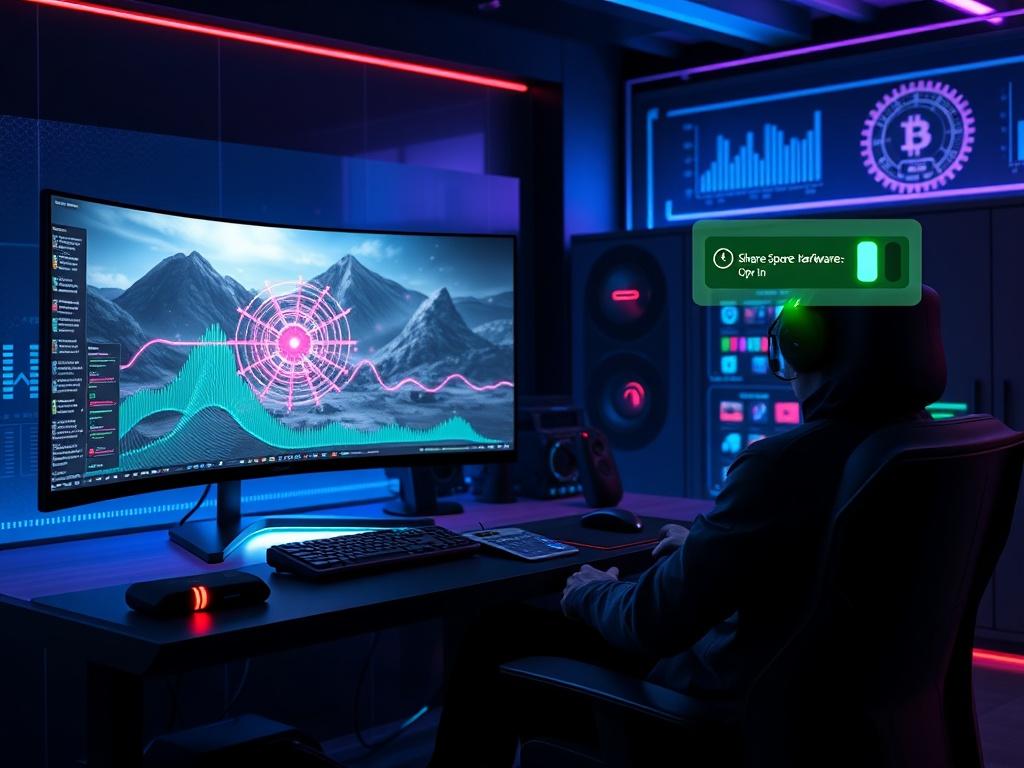
Future Gaming — Optional Hardware Sharing for Playtime Mining
Introduction
Imagine buying a game that offers a permanent discount if you allow the developer to use a small portion of your PC or console hardware while you play. That seems futuristic, but not far-fetched: with rising development costs and players seeking cheaper access, an opt-in “share your spare hardware” feature — used for tasks like cryptocurrency mining, distributed rendering, machine learning work, or cloud simulation — could become a mainstream business model. At the same time, reports of memory leaks and crashes in some titles have led players to joke that games might already be secretly mining in the background. This article explores the technical, ethical, legal, and environmental angles of an explicit, safe, and user-consented hardware-sharing future for gaming.
How an Optional Hardware-Sharing System Would Work
Basic model
Users would get a clearly labeled opt-in option that allows a game launcher or a trusted system-level client to run low-priority background tasks. In exchange, the player receives benefits: reduced upfront cost, in-game currency, subscription discounts, or other perks. The distributed work could be cryptocurrency mining, contributing to distributed computing projects (e.g., protein folding), or participating in rendering farms.
Technical mechanisms
Safe implementation would use robust resource management: strict CPU/GPU usage caps, thermal throttling, battery safeguards on laptops, and dynamic scheduling to ensure the game’s performance is never impaired. Containers, sandboxing, and OS-level APIs would isolate background tasks. Developers could leverage existing frameworks for low-priority compute (nice/ionice equivalents, GPU QoS, job schedulers) and utilize attestation signatures so the client can be verified as legitimate.
User controls and transparency
The UI should provide granular controls: percentage of CPU/GPU allocated, time windows, performance caps, and an immediate kill switch. Real-time dashboards would show resource usage, estimated earnings, and environmental impact (energy consumption and carbon estimates). Crucially, all agreements must be explicit and easy to understand.
Why Some People Suspect Secret Mining
Memory leaks and crashes as red flags
Memory leaks, sudden crashes, and unexplained thermal spikes sometimes accompany poorly optimized games. While most are genuinely due to bugs, players have good reason to be wary: cryptojacking (malicious mining) exists in the wild, and a game that surreptitiously runs heavy background workloads would present similar symptoms. The juxtaposition of bugs and hidden mining has fueled suspicion — especially when elevated CPU/GPU usage persists even with the game minimised.
How true stealth mining would behave
A secretly mining application might avoid obvious CPU spikes by using lower CPU but heavier GPU utilization, or by running intermittently. It could masquerade as a legitimate process, inject into game-related binaries, or create services that restart on crashes. Those techniques are classic signs of malware and are why transparency and signed clients are essential for any legitimate program that performs background compute.
Detection, Forensics, and Prevention
How gamers can detect unwanted usage
Simple tools can reveal hidden workloads: Task Manager, top/htop, GPU-Z, Process Explorer, netstat, and hardware monitors (HWMonitor) show CPU/GPU utilization, power draw, and network connections. Sudden unexplained use when the game is idle, high hash-like GPU loads, or outbound connections to known mining pools are indicators. Logs and certificate checks (signed binaries) also help verify legitimacy.
Developer-side safeguards
Developers should ship signed executables, publish source or audits where feasible, and use secure update channels. Isolating background tasks into separately signed modules, using trusted execution environments (TEEs), and providing verifiable proofs of work (or contribution) can build trust. Independent third-party audits and published telemetry can further reassure users.
Economic and Environmental Considerations
Who benefits and who pays
Revenue-sharing models could make games cheaper for players and diversify funding for studios. But the economics depend on profitability: consumer hardware, electricity costs, wear-and-tear, and the efficiency of the task (e.g., modern GPUs are optimized for specific workloads; mining profitability fluctuates). Transparent accounting and fair splits are necessary to avoid exploitation.
Energy use and carbon footprint
Background compute increases energy consumption. Any responsible system must estimate and disclose energy use and carbon impact, offer opt-out during high-grid-carbon periods, and incentivize using renewable energy. Otherwise, the model risks backlash for promoting higher emissions under the guise of discounts.
Legal, Ethical, and Consumer-Protection Issues
Consent and disclosure
Mandatory, informed consent is non-negotiable. Hidden mining is illegal or actionable in many jurisdictions, and consumer protection laws require clear disclosures for any feature that monetizes user hardware. For minors, parental consent rules add another layer of regulation.
Privacy and security
Background modules must not collect unnecessary data. Any telemetry should be anonymized, minimal, and optional. Security best practices and independent audits reduce the risk of these modules becoming attack vectors for third parties.
Design Principles for a Trustworthy Implementation
Transparency and control
Opt-in only, detailed logs, live dashboards, granular caps, and a one-click kill switch. UI copy should avoid dark patterns and clearly state both benefits and costs (including estimated electricity cost and device wear).
Technical guarantees
Performance-first scheduling: the game gets priority. Background tasks should pause or scale down automatically during gameplay peaks. Use sandboxing, signed code, and cryptographic attestation. Provide downloadable proofs or receipts of work contributed and credits earned.
Independent verification
Third-party audits, open-source modules where feasible, and published telemetry create accountability. An industry standard or certification (like a “SafeSharedCompute” badge) could help consumers quickly evaluate trustworthy implementations.
Practical Recommendations for Gamers and Developers
For gamers
Only opt-in to well-documented programs with signed clients, independent audits, and clear controls. Monitor CPU/GPU usage and device temperatures. Prefer time-limited or capped sharing, and avoid enabling sharing on battery-powered or thermally constrained devices.
For developers and publishers
Be transparent from day one. Offer honest cost/benefit breakdowns, provide performance guarantees, implement strong isolation, and budget for audits. Consider non-crypto distributed tasks (scientific computing) to avoid regulatory and reputational risk.
Conclusion
Optional hardware sharing while gaming could open new monetization paths and lower barriers to entry. But success depends on trust: explicit consent, strong technical safeguards, transparent accounting, and environmental responsibility. Memory leaks and crashes understandably stoke fears of hidden mining, but those concerns can be addressed by making the model visible, verifiable, and controllable. If done right, a future where players trade a slice of spare cycles for lower prices or perks — and know exactly what they’re trading — is plausible and could be beneficial. If done wrong, it risks becoming another vector for abuse and a PR disaster for the industry.
Share This
Latest Blog


Этическая дилемма искусственного интеллекта
17 Sep 2026
ИИ и автоматизация в производстве
17 Sep 2026
ИИ в прогнозировании рынка недвижимости
10 Sep 2026
The Economics of Artificial Intelligence
08 Sep 2026


KI in der Landwirtschaft: Die Zukunft ernähren
01 Sep 2026